Monday, 2 February 2015

Narrative Illustration - Process Research

Now that I have read the book and have an understanding of at least some of the work, I now need to think about how I am going to illustrate the scenes. To gain a better understanding of the process, I am going to be looking at established artists and the processes they use to achieve their finished designs.

Dan Yaccarino

Dan was born in Montclair NJ, and attended Otis-Parson school of design and graduated from Parsons school of design. He had worked freelance and for a number of publishers, his freelance clients include, New York Times, Rolling Stones, Business Week, The Boston Globe and many more.

He has illustrated a number of childrens books as well as writing his own. Titles include Big Brother Mike, Bam, Bam, Bam, One hole in the Road and Goodnight Mr. Night.

He has taught at Parsons school of Visual Arts and Montclair State College and exhibited work in a number of shows including a one man show at the Dance Theatre Workshop Gallery.

Dan has won a number of awards for his work, including Communication Arts, American Illustration, How International Design Annual, Society of Illustrators and Studio Magazine.

Dan Yaccarino


Dan Yaccarino - Process


  • Interpretation of the script. He does this by breaking the story into pieces, identifying the 'peaks' of the story and the relationship between the illustrations and the text.


  • Sketching and Thumbnails. All sketching and rough work is done using 'inconsequential paper'. This being cheap and if mistakes are made, the work can be discarded without any care for the materials lost. Ideas begin here and its important to keep energy levels and enthusiasm high.
  • Colour palate is kept simple.
  • Using one large piece of paper, Dan blocks out the 32 pages deciding what goes where, working out the rhythm of single and full page spreads.
  • Once this page is done,it can be cut up and rearranged.


  • Here Dan is playing with several different fonts, trying to decide which one to use.
 

  • The pages of the book are then printed on Xerox paper and cut up. Here Dan then plays around with the composition of each page, altering the layout until he is happy with the look and flow.
  • This 'dummy book' is then presented to the editor and art director who look at each page and feed back any changes they feel need to be made.
  • Once everything is approved, Dan can then start to create the finally illustrations. This is when he uses the more expensive Arches 300-pound cold press paper which comes in 30-40inch sheets. He cuts these down to 11-15inch pages, which is the size of the book.


  •  Sketching is done using a very light pencil and colour is applied.
  • To finish, Dan uses a gentle gum eraser to eliminate any unnecessary guide lines or pencil marks. Each page taking roughly 1-2hours.
  • If any thing needs changing at this stage, a whole page would need to be redone. 

Patrice Barton - Sweet Moon Baby


Sweet Moon Baby is an adoption story, written by Karen Henry Clarke and illustrated by Patrice Barton.

Patrice has such a beautiful, loose style when it comes to sketching which is still present in the final images. It's dream-like and wistful. She starts off very loose and rough drawings and builds up over and around them with tracing paper.

She too uses thumbnails and partial pieces to develop the layout and composition. The colour palate is bright and vibrant in the finished illustrations, but the work she shows to the editor for confirmation are black and white but still have a lot of depth and tone.

https://www.youtube.com/watch?v=Xxn6fJms_JM

The above link is a short video in which Patrice explains her process and shows off some of the beautiful sketches as well as the finished book.


Wednesday, 28 January 2015

Module Two - Narrative Illustration

In this module, we need to apply 'narrative' to our work. The work I have done so far, might have a narrative already but not to the level being asked for now.

We have a list of books from which we must choose one to illustrate. 

Book List

The Wind in the Willows – Kenneth Grahame
Treasure Island – Robert Louis Stevenson
The Princess Bride – William Goldman
James and the Giant Peach – Roald Dahl
The Big Book of Nonsense – Colin West
The Three Mulla-Mulgars – Walter de La Mare

Wuthering Heights – Emily Bronte
Oliver Twist – Charles Dickens
Catch 22 – Joseph Heller
The Hobbit – J.R.R Tolkin
Northern Lights – Philip Pullman


Batman: Arkham Asylum – Grant Morrison / Dave McKean
Sin City Volume 4: That Yellow Bastard – Frank Miller
Judge Dredd: Shooters night.
Listening to the Earth Turn - Jason Aaron
Chain of Command - Andy Diggle
Nobrow – Graphic narrative – Exclusion – Sam Arthur

The Castle – Franz Kafka
Trainspotting – Irvine Welsh
Animal Farm – George Orwell
Fifty Shades of Grey – E L James
White Bones – Grahame Masterton

Blow by Blow: The story of Isabella Blow – Detmar Blow / Tom Sykes
Necronomicon: The Best Weird Tales – H.P Lovecraft
A Princess of Mars – Edgar Rice Burroughs
The Artificial Man – Leslie Purnell Davies
Dracula – Bram Stoker


I have chosen Animal Farm by George Orwell.

George Orwell wrote Animal Farm in 1945 and published by Martin Secker and Warburg for Penguin books. It has been reprinted many times since and is one of the most well loved pieces of literature even today, as many of the underlying messages and satirical jibes still apply today.

Animal Farm - A Fairy Story, is anything but a children's tale, though the style in which Orwell writes and uses description is done in such as way as if he reading to a child, which could be interpreted as Orwell making yet another point within this work, that the reader needs it spelt out in such a way as to be alerted to the problem.

Orwell wrote the tale as a response to the rise of Communism in the (former) Union of Soviet Socialist Republics (USSR) and many of the characters in the book represent an aspect or notable person of interest from that time.

Manor Farm (as it is called before the animals come to power) is run by Mr. Jones, who is cruel to the animals under his care and lacks the ability to run the farm effectively. It isn’t long till the animals have had enough and drive Mr. Jones from the farm, renaming it ‘Animal Farm’.

Following the rebellion, the days are better for the animals and all pitch in to harvest the seasons crops and care for one another, doing a much better job than the previous owner. Most of the animals do what they do best and aside from one or two, help in the upkeep of the farm. Even the pigs at first, get stuck in though stick to mostly supervisory rolls, being the most intellectual animals on the farm. They take charge of directing the workforce and innovating in their ideas, non-more so than Snowball.

Things run smoothly for a while, until one pig in particular (Napoleon) becomes hungry for power and drives Snowball from the farm, with the help of the dogs he has raised as his own private army.

It is clear by this point that Napoleon’s interests are primarily for himself and pretty soon, the farm is being run with the same level of brutality and contempt as they were under Mr. Jones, though non of the animals realise this.

By the end of the book the pigs are now so much like their previous human custodian that the other animals are unable to tell the difference anymore, but are now so beaten down and disillusioned that they do not have the will or means with which to fight back again.


Characters

Illustration by Ralph Steadman


Old Major


Old Major is the wisest animal on the farm and is the one who brings the idea of rebellion to the others.

The Major represents Karl Marx who came up with the key principles behind Communism.


Napoleon


"Napoleon was a large, rather fierce looking Berkshire boar, the only Berkshire on the farm, not much of a talker, but with a reputation for getting his own way." - Quote taken from Animal Farm, page 15, second paragraph.

Napoleon represents Joseph Stalin and his rise to power within Russia during the mid-1920's.


 Snowball


"Snowball was a more vivacious pig than Napoleon, quicker in speech and more inventive, but not considered to have the same depth of character." - Quote from Animal Farm, page 15, second paragraph.

Snowball represents Leon Trotsky, leader of the opposition during Stalins rise to power. He was deported from the country upon his defeat and was assassinated on Stalin's order in August 1940. He opposed the Stalinist bureaucracy until his death.


Boxer


“Boxer was an enormous beast, nearly eighteen-hands high, and as strong as any two ordinary horses put together.” - Quote from Animal Farm, page 6.

Boxer doesn’t represent any one person in particular, what he does symbolize is the numerous, hardy working classes of Russia. He is friendly and eager to work, taking great pride in what he is able to accomplish, however he is also some what responsible for Nepoleon’s rise to power. Out of all of the animals he is the one could have stopped it in its tracks, but didn’t have the sense to do so.

This fact is the most obvious during the first slaughter by the dogs, when one is driven by blood lust and ends up lunging for Boxer. The sturdy horse is able to render the dog immobile and is quite prepared to kill the creature if Napoleon wished it so. Instead Boxer lets the dog back up on Napoleon’s order.

This says much about the power Boxer (the people) has and if he only had the sense, he could have quite easily over-thrown the tyrannical pigs.


Benjamin


Benjamin is by far the oldest animal on the farm. He never lets himself get carried away, even after they successfully win the farm from Mr. Jones, Benjamin either refuses or simply can not get excited about their accomplishment, seeming to realise long before the finale, that the changes they have made ultimately count for nothing. There will still be hunger, hard work and hardship.

His motto throughout (which may or may not account for his cynicism) is “Donkey’s live a long time, you’ve never seen a dead donkey.” This could be interpreted as ‘he is old enough to have seen it all before’ and if that is the case, he knows that nothing really changes for the animals.


Squealer


Squealer is quite obviously Napoleon’s propaganda machine, able to (and without conscience) spin a tale to the other animals, especially if it serves the interest of Napoleon and thus, himself.

He is a coward and often absent when the farm is in need of defending or if there is hard work to be done, his talent truly is the lies he is able to wield with conviction. Some of his reasoning behind the events at the farm, for example the discontinuation of the weekly meetings are definitely hiding underhand, ulterior motives, but none of the animals can find it within themselves to argue, especially when Squealer ‘‘prances back and forth, swishing his tail’. This could be an indicator to the way Stalin used the media to bombard the people with news or events that distracted them from the real problems.


Nine Dogs


The nine dogs are the puppies that Napoleon takes away and are ‘educated’ by the aspiring boar.

The next time these misguided canines are seen is the night that Snowball is driven from the farm, with these nine vicious dogs snapping at his heels.

These dogs represent the Narodnyy Komissariat Vnutrennikh Del (NKVD the Russian secret police). These were responsible for many disappearances of people who Stalin perceived as a threat and this is touched upon in the book several times, most notably when Napoleon has the dogs savage some of the animals who ‘confess’ to be in league with the ‘traitor’ Snowball.

Orwell also draws attention to the fact that the dogs look to Napoleon the same way they looked to Mr. Jones, with wagging tails. This is a huge indicator of the things to come by the end of the book.


Moses the Raven


Moses the Raven represents the persecution and the reinstatement of the Russian Orthodox Church.

Moses was the favorite family pet of the Jones, this refers to the union of the Tsar and the church and their relationship.
When the Jones’ are driven out, Moses disappears also, taking his tales of Sugar Candy Mountain. Sugar Candy Mountain, according to Moses is a place where animals go to after they die. It is a good place, with no work to be done and there is always enough to eat (Heaven).

Once Napoleon has a sure fast control and requires the animals to continue to defend the farm, he allows Moses and his tales to return and pays the Raven a ‘Gill of Beer’ a day. By doing this he is hoping to placate the animals as they now contend with the hardships they face under Napoleons rein. Moses becomes another kind of control.


Mollie


Mollie is pretty, vain and materialistic horse who represents the middle classes of Stalin’s Russia, the bourgeois.

From the very beginning of the book, when the rebellion is still young and not yet acted upon, Mollie’s concerns lie with whether there will be ‘sugar cubes’ and ‘ribbons’. These represent the material wealth of the bourgeois that they were asked to give up. Most did not and instead, fled to the west.

Mollie flees and joins a neighboring farm and is seen soon after, pulling a cart with the ribbons she adores once again in her mane.


Clover


Clover is the female counterpart of Boxer and likely represents the female perspective of the Russian working classes of the time.

She is more perceptive than Boxer and has many moments where she recognizes what the pigs are doing goes against what they first set out to do in the early days of the rebellion, but like Boxer she is unable to vocalize her thoughts.

“As Clover looked down the hillside her eyes filled with tears. If she could have spoken her thoughts, it would have been to say that this was not what they had aimed at when they had set themselves years ago to work for the overthrow of the human race. These scenes of terror and slaughter were not what they had looked forward to on that night when old Major first stirred them to rebellion.”

This excerpt from the book, written from Clover’s perspective clearly states that while she understands that only terrible things are happening, she doesn’t possess the tools required in order to speak out.

Could Orwell then be saying that, if the female working classes had a political voice or a way to speak out against these atrocities, they may not have happened or could have been stopped? She is after all a horse like Boxer, strong and the second largest animal on the farm.


The Sheep


The sheep on the farm represent the masses of people who were blindly following the propaganda (Squealer). There use of short bleated mottos, like “Four legs good, two legs bad” is all these simple minded creatures were able to understand. Anything more complex was lost on them. They are easily swayed and ultimately not very intelligent because by the end of the book, Squealer has the sheep bleating “Four legs good, two legs better” just in time for when the pigs themselves start to walk on their hind trotters only…


Hen’s


The hens under Jone’s reign have their eggs taken and sold daily and are given very little food and care. When the rebellion happens they are assured that they would not have to part with their eggs anymore, so when Napoleon demands they do so, they are understandably upset and rebel. Withholding their eggs and instead choose to smash them during their own revolt.

This represents the Ukrainian peasants who revolted under Stalin who wanted them to ‘collectivize’  their produce. Instead of doing this, they choose instead to slaughter their own livestock (breaking of the eggs).

The hens are then starved and nine of them end up dying. This number is no where near the amount of Ukrainian farmers who were also starved to death under Stalin’s regime, between four and ten million peasant farmers died.


Cows


The cows represent the wealth of the farm, they produce a highly sought after commodity, milk. One the pigs at least desire and the cows are happy to supply it, they simply want to be milked.


Tuesday, 13 January 2015

Book of Drawings - Content

I have decided to continue to use digital imagery to put in my book, but to try and stick with the far eastern theme.


This is a Photoshop painting of my daughter Chloe. This was based on a picture we took of her sometime ago. It was such a lovely picture I just wanted to do something with it. I used a soft edged brush and kept the colours warm. This might not be typically far eastern in technique or subject matter but it was a good subject matter to display my skills with Photoshop.

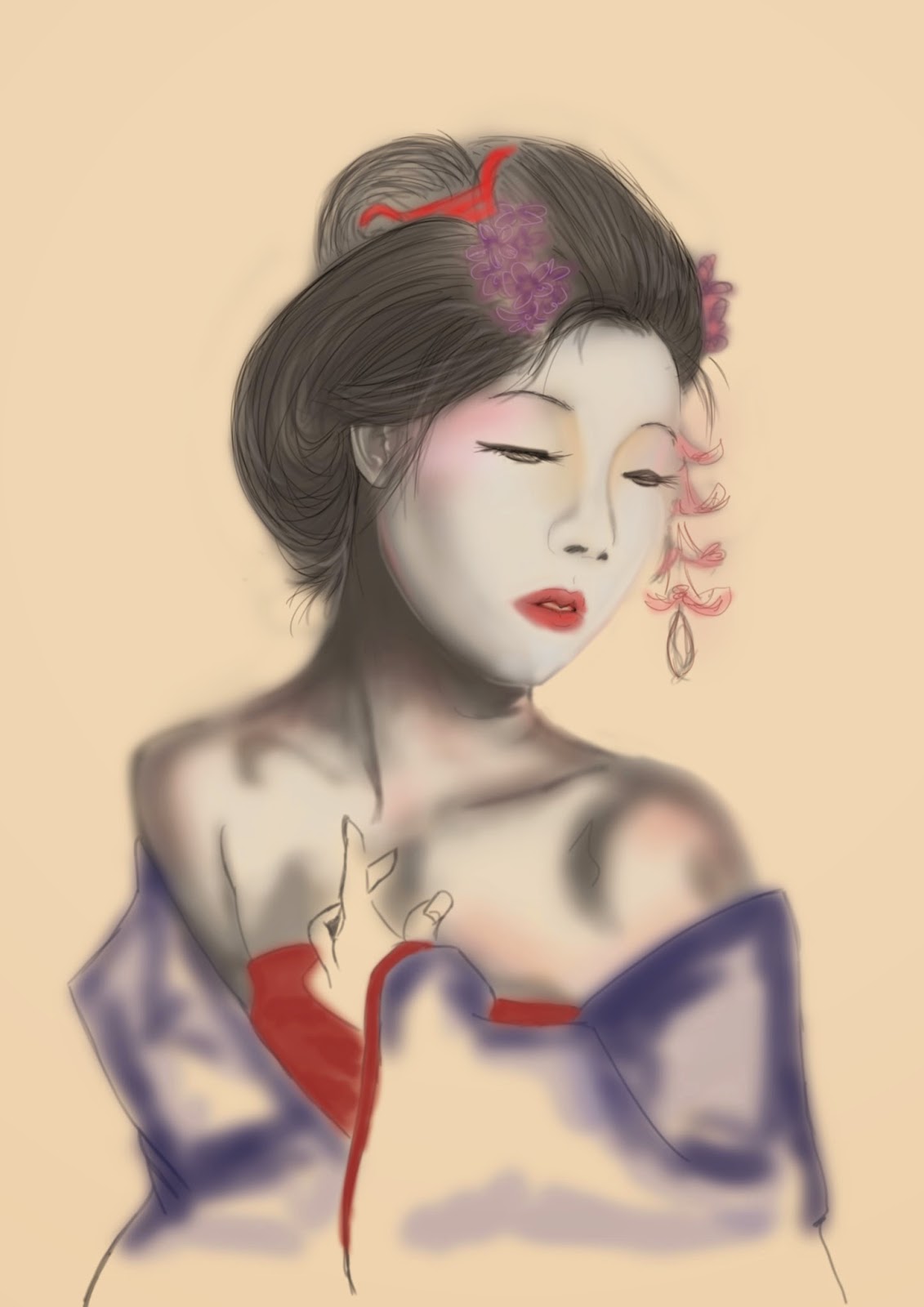
A Geisha is an easily recognized figure or Japanese culture. I wanted to create quite a naïve, unfinished image. Again linking to Wabi-Sabi, the beauty in the incomplete. This was done using Photoshop, with a variety of brush types to achieve both soft and sharp edges. 


This is a painting done using Paint Tool Sai. Here I have tried to incorporate a more impressionist image of the Koi, using single strokes of the water brush to manipulate the colours to capture the form of the fish. This is emulating Chinese Brush Painting technique, capturing form rather than detail and exact likeness.

The tiger is one of the most magnificent creatures in the world and I wanted very badly to present even just a portion of that presence in this piece. Again I wanted to go for form and flow rather than exact likeness.

Because most of these pieces are digitally created, this means to get them into the book, I need to print them out and stick them down. While this will get the job done, it seems a little boring, so I am contemplating using another technique called 'Image Transfer'.

 
This was the first image transfer I had done that
was a complete success.
It is the Two Koi on thick card,
with lotus flowers painted on the finished image.

Image Transfer is quite simple but time consuming procedure.

After covering the surface you wish to transfer the image on to with white acrylic paint, you place the laser jet printed picture face down onto the wet paint and smooth down. Once dry, spray the back of this picture with water and, being careful not to rub to hard and remove the paint underneath, the idea is to remove the now soft paper little by little, with gentle circular motions.

Once most of the paper has been removed, a gloss medium can be used, which permeates the marginal amounts of paper to allow the colours to show through the white fluff that's left behind.

The effect is very pleasing but so many things can go wrong. It also has its downsides which unfortunately make it unsuitable to use the way I had hoped in my book.

  • It is possible to rub away the picture
  • Not all of the paper can be rubbed away without damage to the image
  • It can take a number of hours to shave away the layers of paper away
  • A more durable surface is required for the transfer to be a success
  • The image can appear misty and colours don't seem as vibrant.

Because of these drawbacks I have decided not to use the Image Transfer technique. 


Book of Drawings - The Construction

Now that I have an idea of the direction I want to go in for my finished book, I can now start to put into practice my ideas.

Since I had a very good idea in my mind of what I wanted my book to look like, I have made it with very little trouble, decorating it with pale blue paint and stencilling the design using Gesso (acrylic white paint, PVA glue and talcum powder mixed together to create a paste that hardens upon drying).


Finished book, without final design


Book with beginnings of the final design.


Originally I said I would like to attempt to recreate the Chinese brush paintings, digitally. With this in mind I have become familiar with another piece of software called Paint Tool Sai.

I have had this program for a number of years, but have not had a chance to put it to much use until now. It operates similarly to Photoshop, with one additional feature. Paint Tool Sai has a unique water brush designed to create the subtlety of a wash of watercolour.

I have seen the program used by those more familiar with the program and the effects you achieve are very pretty.

I can also use Photoshop to create some ink type paintings, but this depends on being able to download new brush types and then experiment with them.


This is one of my first experiments with Paint Tool Sai. Here I have attempted to create the image of a Blue Crested Heron standing in the water. Around it are pink blossoms.

The colours are very soft as I have attempted to create a gradient effect. The black ink strokes I wanted to keep quite bold and imperfect, linking to the Japanese philosophy of Wabi-Sabi, a happy accident.

All in all I am very happy with this painting. The composition and the strokes are quite appealing.

This is one for the book.

Book of Drawings - Research

For this final module of the current brief, we are tasked with creating a book and filling it with (a minimum of) six drawings, which should in some way reflect the work we have been doing this term.

  • Reportage
  • Animals
  • Digital
  • People and Characters


Art Books.

Art books are basically sketch books. A book filled with not only the artists work, but the book itself becomes a piece of art also. From designing the covers, to the type of, and way in which the paper is used can have some very visually impressive results.


Concertina Books consist of a front and back cover, that are connected via the folded connecting pages of the signature. They can be decorated with other folds, creating pockets that conceal other pages or embellishments that contribute to the books over all design or theme.
When open, the book is free-standing, making this a good choice if you are looking to create a book for a display.

Books don't just have to be made with paper. Above is a Bamboo book and as you can probably tell, originates from China. The pages consist of carved and polished pieces of bamboo, which are bound together with waxed linen thread.
This book unfolds like a concertina book but lacks the rigidity to stand up in the same way. This does not change the fact that it would look just as good as a display piece.
The pages are decorated with ink and prints.


My Book

Embossed, leather bound book.

For my book, I want to go a more traditional route. A regular book that opens and you read front to back.

During the last few months in our visual culture lectures we have been learning a lot about the influence of Far Eastern art on the European market and art scene. I was very impressed with the style and beauty of the traditional works in both Japan and China, and to a lesser extent, the work that was influenced by it here in Europe.

I am focusing on Japonisme for my visual culture essay and I would like to reflect at least some of these influences in my book design and the work that it holds.

Jasper Ware Vase.
 
Once trade with China and Japan was established, a number of new materials became available to artists and craftsmen back in Europe, one of which was Porcelain.

It was known for its matte finish and came in a number of different colours but is mostly known for the pale blue shade known as Wedgewood Blue.

I adore the clean crispness of the white on blue. The way it's layered, to create the depth of the imagery. It is something I would like to replicate (or at least attempt) for the cover and design of my book. 

Far Eastern traditional art is also very beautiful. Painting alone is not the main focus of Chinese or Japanese art, many of the techniques are used by craftsmen and women. Paper cutting and Lacquer work to name a few, but the East have a wonderful style and technique when it comes to creating imagery.


One of the most famous Japanese artists Katsushika Hokusai, created some of the more memorable wood prints. The most note-worthy being The Wave off Kanagawa in the series Thirty-Six Views of Mount Fuji.

Chinese brush painting is also very beautiful, with a very distinct style. It also requires a specific technique, one that takes years to master.

Sparrows Playing in Bamboo Forest
Qiao Mu 1998

The technique is very expressive and requires a lot of control of the brushes, which are made specifically for each type of stroke, and it is these strokes that make up the components of the image. For example, you would not use the same brush to create the leaves of the bamboo as you would the stem.

The inks used are of differing dilutions and up to three different shades of ink can be loaded onto one brush before being applied to paper, creating a gradient effect. This is especially good for creating depth or the various shades of an image.

This technique can create some incredible scenes and it is something I am curious about artistically. I am wondering if it would be possible to re-create these images digitally.